
You’ve looked at your water bill, and something doesn’t add up. You know your household isn’t using this much water, and now you’re staring at the metre wondering what it’s actually telling you. What do the numbers tell? How can you tell if there’s a leak?
This guide walks you through exactly what to look for. You’ll learn how to read the key numbers, understand what they mean, and spot any unusual water use with a few simple checks.
By the end, you’ll be able to check your water usage confidently, identify hidden leaks fast, and take control of your bills.
TL;DR
- To read your metre, note kilolitres for total usage and litres for daily use. Take readings at the same time on different days and subtract the earlier value from the later one to calculate water usage.
- The location of the metre in most houses is in the front boundary. Units may have individual metres or a shared main metre, so check with your body corporate if unsure.
- To detect leaks fast:
- Perform a 15-minute test for active leaks by turning off all taps and appliances.
- Do an overnight test to catch slow or intermittent leaks.
- Use the isolation valve to see if the leak is inside your home (your responsibility to fix) or outside (the council’s responsibility to fix).
- If the metre shows no leak, but your bill is high, it may be estimated or misread. File a dispute and send a self-reading and a clear metre photo.
- If the metre shows a leak and that too inside your home, inspect toilets, taps, showers, hot water system valves, and garden areas for visible leaks.
- Call a licensed plumber for complex setups, shared main metres, or hidden leaks. For concealed leaks repaired by a licensed plumber, you may apply to Townsville City Council for a financial adjustment.
Where to Find Your Water Meter
In Townsville homes, the metre is installed out the front of the property, typically positioned along either the left or right boundary line.
If you live in a unit or townhouse, the setup depends on the building.
- Newer complexes: Each unit usually has its own metre. These are often grouped in one place, like near the front entrance, along a side path, or inside a shared cabinet.
- Older complexes: There may only be one main metre for the entire property.
If there’s only one main metre, you can’t use it to track just your own water use or confirm a leak specific to your unit. It only shows the total water going into the whole building. In that case, leak checks need to be handled at a building level, or you’ll need help from the body corporate (the management group responsible for shared parts of the building) or a plumber who can isolate your unit’s supply.
Once you are in the metre area, now look for the metre itself: in most houses, it’s installed in the ground inside a small rectangular box. In units or townhouses, it may be:
- In the ground like a house, or
- Mounted above ground in a cabinet or along a wall, especially in newer builds.
If it’s in the ground, check for a covered box called a metre pit. The lid is usually labelled “Water Metre” or “TCC” (Townsville City Council), confirming you’ve found the correct metre.
How to Read Your Water Meter Step by Step
Step 1: Open the Metre Box and Access The Display
Once you have found the metre box, lift its concrete or plastic lid. If it feels stuck because of dirt or sand, use a flat-head screwdriver or a similar tool to gently pry it open.
Once opened, you will see the water metre assembly, which consists of three main parts:
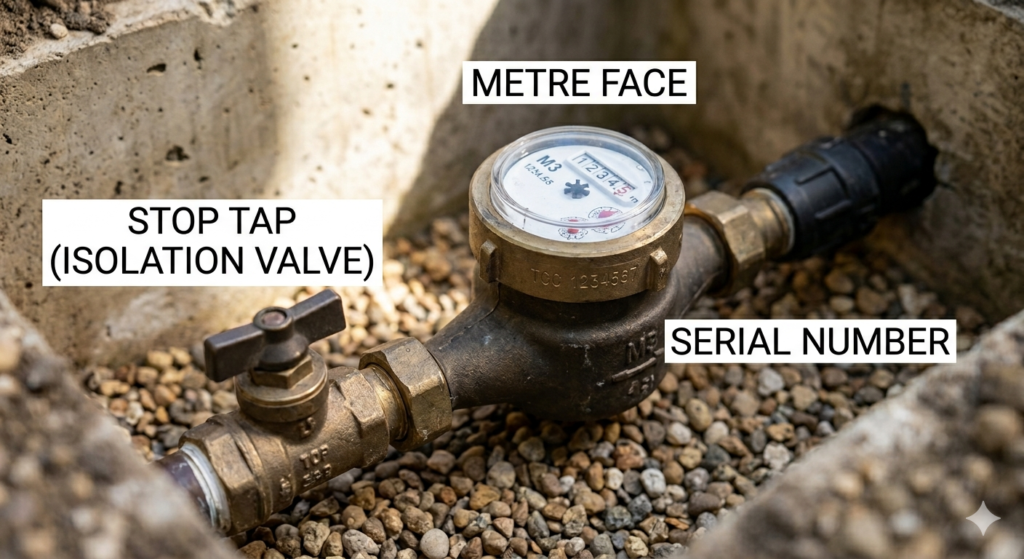
- The Metre Face: This is the main part you’ll read. On older metres, it’s a dial with numbers. On newer ones, it’s a digital screen. This is what records all the water that passes into your home.
- The Serial Number: This is a unique ID for your metre, which is often stamped on the metre or under the lid and starts with letters followed by numbers (for example, TCC 1234567). Match this with the metre number on your water bill to make sure you’re reading your metre, not someone else’s. This step is important if you live in units or townhouses where metres can be close together.
- The Stop Tap (Isolation Valve): This is the handle or lever on the pipe leading into the metre. Turning it clockwise shuts off the water supply to your entire home.
Once you can clearly see the metre face, you’re ready to move on to actually reading the numbers.
Step 2: Read the Kilolitres (kL)
Mechanical metre Digital metre
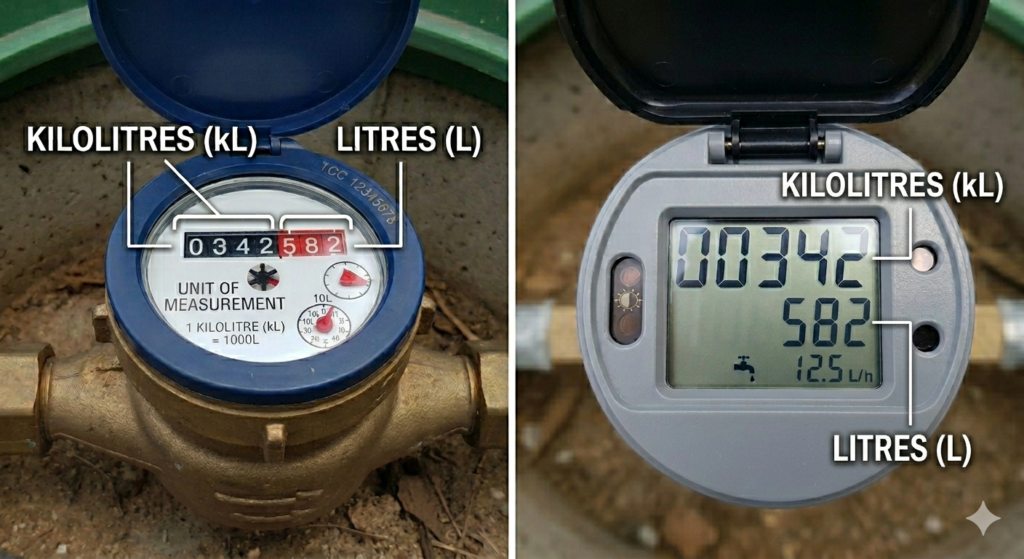
The first set of numbers shows how many kilolitres (kL) of water have passed through your metre since it was installed. One kilolitre equals 1,000 litres. This is the only figure Townsville City Council uses for your quarterly water billing because it represents the total water consumption in large, standard units, making billing easy.
- On a standard mechanical metre, focus on the black numbers on the left. For instance, if the metre reads ‘00342’ in black, you have used 342 kilolitres.
- On a digital smart metre, look at the large numbers on the top row of the screen. These show the same thing, your total kilolitres. If the screen is blank, flip the protective lid or briefly cover the light sensors with your hand to activate the display.
Step 3: Record the Litres
The second set of numbers tracks individual litres. These move much faster than the kilolitre digits and are useful for spotting small leaks or tracking short-term use like a single shower or load of washing.
- On a mechanical metre, these are the red numbers, mostly 3 digits, to the right. For example, if the red digits show 582, it means you have used 500, 80, and 2 litres, respectively.
- On a digital metre, these appear as smaller digits on the bottom row. Some models show decimal points, letting you see usage down to very small and precise amounts.
Step 4: Calculate Your Usage
To find out how much water you’ve used over a specific period, like a day, week, or month, you need two readings.
- Take a reading of the kilolitres and litres, and note the time.
- Take another reading later (same time next day, week, or month).
- Subtract the earlier reading from the new one. The difference is your water usage for that period.
For example, if your reading was 342 kL last week and 350 kL today, you’ve used 8 kilolitres, which equals 8,000 litres in seven days.
Once you’re done, place the box lid back securely. This keeps dirt and sand from covering the display and protects the metre from heat, weather, and accidental lawnmower damage.
How to Detect Hidden Leaks Using Your Meter
Hidden leaks can run for weeks or months without being obvious, which increases your water bill and damages your home. Your water metre gives you a quick way to confirm if there’s a leak before you bring in a plumber.
Here are two simple ways to detect leaks:
1. The 15-Minute Visual Test (For Active Leaks)
This test is for leaks that are happening constantly, like a running toilet, a split pipe, or a fitting that hasn’t sealed properly.
Turn off all taps, stop any appliances like washing machines or dishwashers, and let everyone in the house know not to use water for the next 10–15 minutes.
Now go to your metre and look at the display.
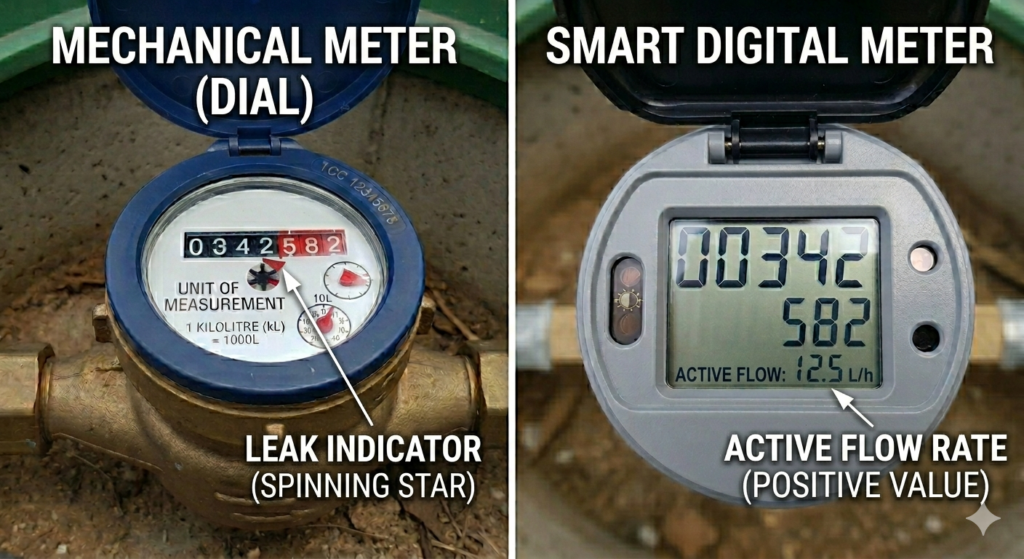
- On a standard mechanical metre, look for a tiny red star, a triangle, or a little gear. This is the flow indicator. If everything in your home is off and that indicator is still spinning or moving, water is flowing somewhere.
- On a smart digital metre: The screen cycles through different readings every few seconds. One of these shows the current flow rate, usually written like “L/h” (litres per hour). If you see any number above 0.0 L/h, it means water is moving through the system right now. You might also notice a small plus (+) sign or a tap icon flashing on the screen, indicating that water is currently flowing.
If the metre shows no movement, it means there’s no active leak.
2. The Overnight Consumption Test (For Slow or Hard-to-Notice Leaks)
Some leaks are too small to notice straight away, or they don’t run constantly, as a pipe joint might only leak under pressure. So, you need to perform an overnight test to find such leaks.
Before you go to bed, take a full reading from your metre. Write down all the numbers, both kilolitres and litres. Then turn off all taps and appliances and make sure no water is used overnight. In the morning, check the metre again before anyone uses water.
Now compare the two readings. If the numbers are the same, there’s likely no leak. If they’ve increased, even slightly, something is letting water through.
Narrow it Down: Inside or Outside
If you found a leak, the next step is figuring out where it’s coming from.
Find the main valve that controls water for the inside of your home; it’s usually near your front garden tap or where the pipe enters the house. Turn this handle clockwise until it stops. This cuts off the water to your indoor taps, toilets, and appliances, but keeps the water moving in the underground pipe between the street metre and your house.
Now go back to your metre and check it again.
- If the metre stops moving, the leak is inside your home. Common causes include a leaking toilet, a dripping tap, or a pipe issue inside a wall or under the floor.
- If the metre is still moving, the leak is outside your home. This means the issue is in the underground pipe that runs from the metre to your house.
Knowing whether the leak is inside or outside helps you explain the problem clearly when you call a plumber, which can reduce time spent diagnosing the issue.
It also matters for responsibility.
- Inside Your Home: This includes pipes, taps, toilets, and appliances. If the leak is here, it is your responsibility to fix it, and you’ll also pay for any water that has been wasted.
- Outside Your Home: In Townsville, the council owns the metre and the street-side pipes. If the leak is here, the council is responsible for the repair, and you are not charged for the water lost.
How to Use Your Meter to Check if Your Bill Is Right
If from the above tests, your metre showed movement when no water is being used in your home and your latest bill is higher than usual without any obvious reason (like filling a pool or hosting guests), you have a confirmed leak. (We will explain later what you need to do in this situation.)
But if your metre showed no movements and your household is using normal amounts of water, but the bill is still higher than expected, the issue is usually not a leak but a billing problem because of the following:
- Estimated Readings: The council may have issued an estimated bill based on past bills if they couldn’t access your metre because of a locked gate, a dog, or blocked metre access. Look for “Estimated” or an “E” on your bill.
- Manual Reading Errors: Although rare, mistakes can happen when a contractor reads your metre.
In this situation, you’ll need to contact your energy retailer before the bill due date and provide them with a self-reading, a clear photo of your metre, and a request that they review the bill and issue a corrected reading.
What to Do After You Find a Leak
- Stop Non-Essential Water Use: Turn off automated systems such as irrigation, pool top-ups, or evaporative air conditioners until you identify the source of the leak. This prevents further water loss while you investigate.
- Conduct a Rapid Check of Common Causes:
- Toilets: Drop a few drops of food dye into the cistern. If the colour appears in the bowl without flushing after 15 minutes, the cistern valve is leaking.
- Taps & Showers: Look for any dripping or slow leaks. Check washers and seals inside taps or shower heads, as worn parts are often the cause of small leaks.
- Hot Water System: Observe the temperature and pressure relief (TPR) valve. It should only release water occasionally under pressure; if it’s constantly running, it could indicate a leak or a pressure issue that needs attention.
- Garden & Yard: Look for unusually green patches, damp soil, or areas of water pooling. These could indicate leaks in underground irrigation or supply lines.
- Toilets: Drop a few drops of food dye into the cistern. If the colour appears in the bowl without flushing after 15 minutes, the cistern valve is leaking.
- Call a Professional When Needed: If you can’t find the leak, contact a licensed plumber or a specialist leak detection service. They use acoustic or electronic equipment to pinpoint hidden leaks without unnecessary digging or damage to your property.
- Understand Responsibility and Act Accordingly: As you already know, outside leaks are the responsibility of the council. But if inside the home, the leaks come in 2 situations:
- Visible leaks in taps, appliances, or exposed pipes are considered standard maintenance, and you are responsible for repairing the leak and covering the cost of lost water.
- Concealed leaks inside walls, under floors, or underground on your property may qualify for Townsville City Council’s Concealed Leak Allowance. To apply for a financial adjustment on your water bill for a concealed leak, the following is required:
- The leak must be repaired by a licensed plumber within 60 days of either discovering it or receiving a high-usage notice.
- You must provide a plumber’s invoice that clearly states the leak was concealed and confirms the date of repair.
- Maintain a record of metre readings and photos before and after repair. This forms the evidence base for your claim.
Once you’ve identified the leak and taken the right steps, make it a habit to monitor your metre regularly. Even after repairs, small issues can reappear, and regular checks help you catch them early and prevent them from becoming major, expensive problems.
Final Thoughts
Keeping an eye on your water metre is one of the easiest ways to stay in control of your water use. Try to check it once a week, or at least once a month, to catch a leak early, or even figure out if a higher bill is actually correct or not.
If you do find a leak, your readings can also help you figure out whether it’s inside your home or somewhere outside in the pipe, which tells you who’s responsible for fixing it.
There are times, though, when it’s not that simple. If you live in a unit with a shared main metre, or the leak is hidden and hard to find, you’ll need a licensed plumber. They can isolate your unit, interpret the metre properly, locate the exact source of the leak, and guide you on how to keep track of your water use going forward.
For homeowners in Townsville, our team at 1touch Plumbing is here to help. Our licensed plumbers will show you how to read your metre readings, track down and fix any leaks, and make sure your water use is being monitored correctly, which saves you time, stress, and unnecessary costs.
Contact us today for expert help you can trust!